
Are We Unemployed Yet?
What is unemployment? News & Fears in 2026.
The Great Employment Contradiction: Why the World Simultaneously Has Jobs and Joblessness
Open almost any newspaper, television channel, or social media feed in 2026 and a common theme appears repeatedly: unemployment. In the United Kingdom, broadcasters discuss shrinking opportunities, weak hiring, and economic anxiety. In India, discussions frequently revolve around layoffs in the IT sector, automation, and uncertain futures for engineering graduates.
The impression created is often one of universal economic decline — as if entire societies are running out of work.
But the real situation is far more complicated.
What the world is currently experiencing is not one single unemployment crisis. Instead, it is a collision of technological change, industrial restructuring, shifting consumer behavior, post-pandemic corrections, and a growing mismatch between what workers are trained for and what industries actually need.
The result is a strange contradiction: Companies claim they cannot find suitable employees, while millions of people simultaneously claim they cannot find jobs.
Surprisingly, both statements can be true at the same time.
The Difference Between “No Jobs” and “Wrong Jobs”
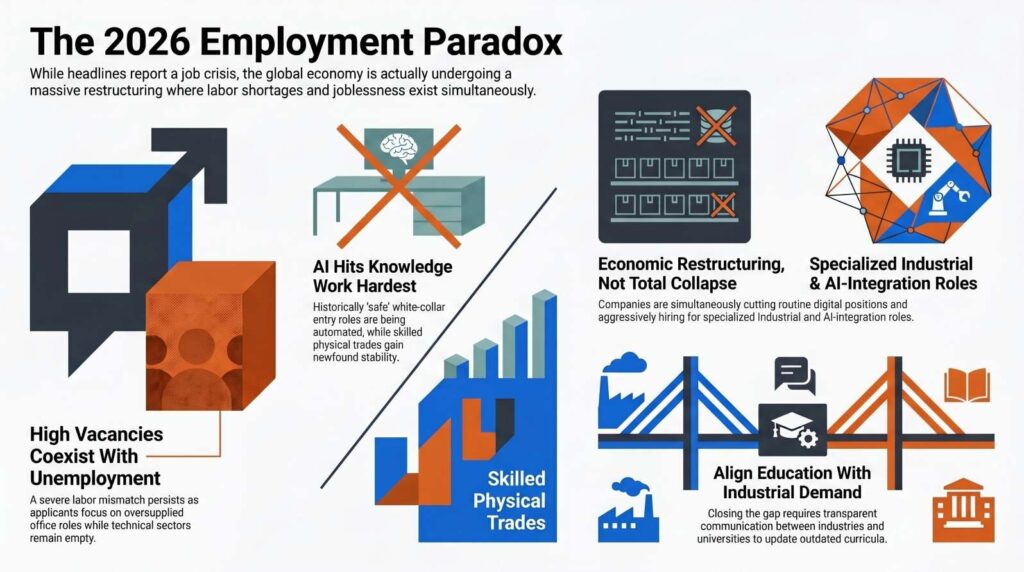
One of the biggest misconceptions in modern employment discussions is the assumption that unemployment always means a total absence of work opportunities. In reality, many economies still contain substantial labor shortages.
Hospitals continue searching for nurses and medical staff. Infrastructure projects require technicians and machine operators. Logistics companies need drivers and warehouse personnel. Manufacturing sectors require industrial maintenance workers, welders, electricians, and specialists capable of handling advanced machinery.
Yet large numbers of educated applicants remain concentrated in a much narrower range of occupations:
- Software engineering
- Data analytics
- Corporate office roles
- UI/UX design
- Marketing
- Administrative positions
- IT support services
This creates a severe labor mismatch.
An economy may technically contain available jobs while simultaneously failing to provide the specific jobs people expected, trained for, or socially preferred. The result is an employment paradox where vacancies and unemployment coexist.
The Situation in the United Kingdom
The United Kingdom is not currently facing Depression-era unemployment. Official unemployment figures remain elevated compared to the ultra-tight labor market seen immediately after the pandemic, but the broader economy has not collapsed. However, the pain is concentrated in particular areas.
Entry-level office jobs have weakened. Graduate hiring in certain sectors has slowed. Retail and administrative roles face increasing pressure from automation and cost-cutting. Younger workers entering the labor market often face far greater competition than previous generations.
At the same time, several industries continue to experience demand for workers:
- Healthcare
- Skilled trades
- Engineering
- Energy
- Specialized technical roles
- AI-related development and integration
One of the deeper concerns in Britain is the erosion of the traditional “first rung” of professional careers. Many beginner-level white-collar tasks — once used to train junior employees — can now be partially automated using artificial intelligence systems.
This creates a structural problem for younger workers attempting to enter professional industries for the first time.
Media coverage often focuses heavily on this phenomenon because it reflects a social anxiety larger than the unemployment statistics themselves: the fear that educated workers may no longer possess the same economic security they once expected.
India’s Employment Reality
India’s situation differs significantly from the United Kingdom’s.
In Indian public discourse, conversations about unemployment frequently center around urban white-collar sectors — particularly information technology, startups, and engineering graduates.
The Indian IT sector expanded enormously during the years of rapid digital transformation and pandemic-driven remote work. Global demand for software services surged, and companies hired aggressively.
That expansion has now slowed.
International clients reduced technology spending. Startups became more cautious. Artificial intelligence began automating portions of coding, documentation, testing, customer support, and repetitive back-office work.
As a result, fresher hiring in many IT firms weakened considerably. But this does not necessarily mean India lacks economic activity.
Several industries continue to expand:
- Infrastructure
- Construction
- Manufacturing
- Renewable energy
- Logistics
- Healthcare
- Defense production
- Industrial operations
- Skilled technical services
The problem is that many educated urban graduates remain heavily oriented toward office-based IT careers, even while other sectors continue seeking labor.
This is not merely an economic issue. It is also cultural and educational. For years, middle-class aspirations in India strongly associated success with software engineering, multinational offices, and white-collar corporate employment. As those sectors become more competitive and automated, societies experience psychological and social friction.
AI and the Uneven Impact on Employment
Artificial intelligence is not replacing all jobs equally. The most vulnerable positions today are typically those involving repetitive digital tasks, standardized workflows, or predictable information processing. These include:
- Junior programming
- Data entry
- Basic content writing
- Routine customer support
- Administrative processing
- Entry-level analysis work
- Documentation and reporting
AI systems can now complete substantial portions of these tasks rapidly and cheaply.
However, many professions remain comparatively resilient because they depend heavily on physical presence, real-world adaptation, trust, responsibility, or human judgment.
Examples include:
- Electricians
- Plumbers
- Mechanics
- Surgeons
- Nurses
- Skilled technicians
- Field engineers
- Industrial operators
- Project managers
In many of these professions, AI functions more as an assisting tool than a replacement.
This creates an unusual inversion in society. Historically, white-collar office jobs were considered safer and more prestigious than physical or technical labor. Today, some skilled physical professions may actually possess greater long-term stability than many routine office careers.
Is the Current Situation Seasonal? Partly — but not entirely.
Every economy naturally experiences cycles. Retail hiring rises during festival and holiday seasons. Agricultural work fluctuates by harvest periods. Construction activity changes according to weather and financing conditions. Corporate hiring often follows budget cycles.
However, the technological sector appears to be undergoing something deeper than a temporary seasonal slowdown. Many firms are discovering that AI systems allow smaller teams to produce similar amounts of work. A company that previously required large numbers of junior employees may now operate with fewer workers assisted by advanced software tools.
This does not automatically eliminate all employment. Instead, it changes the composition of work. Entire categories of tasks become less valuable while new specialties emerge elsewhere.
Historically, industrial revolutions repeatedly transformed labor markets in this manner. The difference today is that the disruption is targeting educated, urban, white-collar professions rather than primarily affecting manual labor. That distinction dramatically changes public perception.
The Psychological Shock of White-Collar Automation
One reason the current moment feels unusually unsettling is because higher education was long associated with stability.
Parents encouraged children to pursue degrees precisely because office-based knowledge work appeared insulated from technological disruption. The expectation was simple: education would guarantee security.
Artificial intelligence is challenging that assumption. For the first time in modern history, large numbers of educated workers are watching automation threaten tasks traditionally considered intellectually specialized. This creates a cultural shock far larger than the raw unemployment numbers themselves. The fear is not only economic. It is existential.
People are beginning to question whether the social contract surrounding education, professional identity, and middle-class stability still functions in the same way it once did.
The Hidden Reality Behind Layoffs
Another important factor often ignored by headlines is that companies frequently lay off workers and hire workers simultaneously. A corporation may reduce hundreds of routine administrative positions while aggressively recruiting cybersecurity experts, AI engineers, cloud architects, industrial specialists, or automation technicians.
The public headline becomes: “Company Cuts 500 Jobs.”
But the underlying reality may actually be: “Company Eliminates One Type of Job While Creating Another.”
This distinction matters enormously. Modern economies are not simply shrinking. Many are reorganizing themselves around different technological and industrial priorities.
The Real Employment Question of the 2020s
The defining issue of this decade may not be whether jobs exist at all. The deeper issue is whether societies can adapt quickly enough to changing labor realities. Millions of workers spent years preparing for specific career paths shaped by earlier economic conditions. Educational systems, parental expectations, social prestige, and cultural narratives all reinforced those choices. But economies evolve faster than institutions.
As industries restructure around automation, energy transitions, logistics, healthcare expansion, manufacturing revival, and AI integration, workers cannot instantly reposition themselves overnight. That lag creates the appearance of widespread unemployment even in economies where substantial hiring still exists.
So what is the fact about employment conditions?
The modern employment crisis is not a simple story of “there are no jobs.” It is a story of transition.
Certain white-collar sectors — especially routine digital and entry-level office work — are experiencing significant pressure from automation, cost-cutting, and post-boom corrections. Meanwhile, many physical, technical, industrial, healthcare, and specialized professions continue to demand labor.
The world economy is not uniformly collapsing. It is restructuring. And during periods of restructuring, societies often experience confusion because old expectations no longer align with new realities.
What appears in headlines as a universal unemployment disaster may actually be something more complex: A global reallocation of work, skills, prestige, and economic value in the age of artificial intelligence.
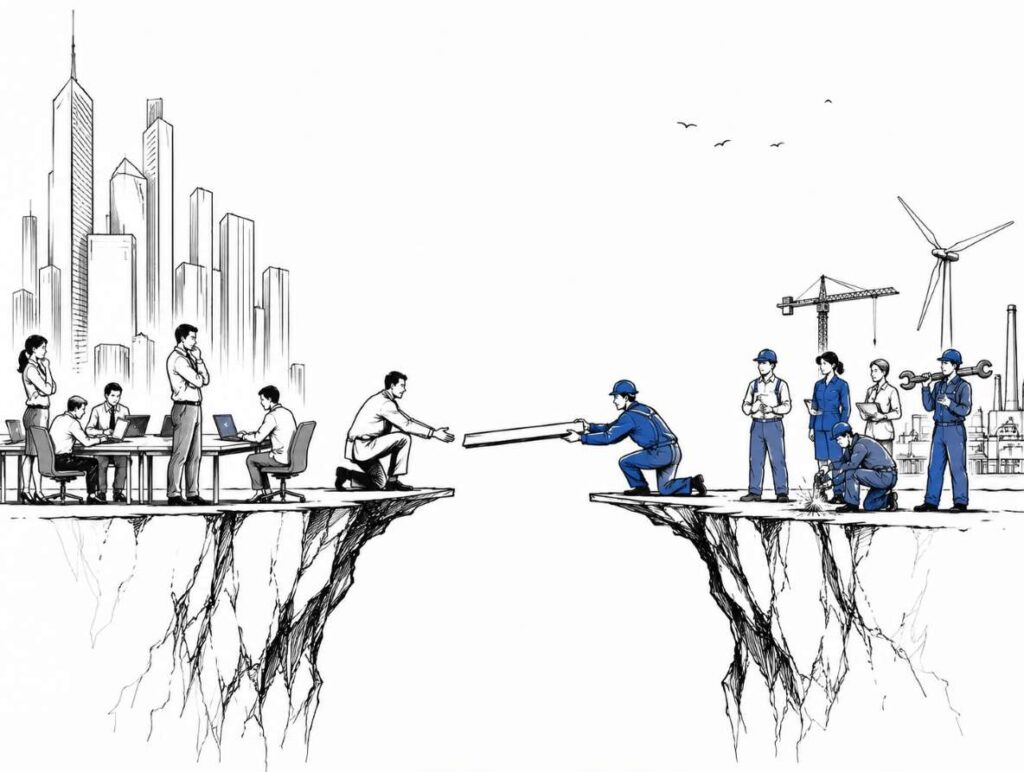
One of the less discussed but increasingly serious problems in modern employment systems is the lack of effective communication between trade bodies, industry associations, academic institutions, government agencies, and the workforce itself — including both employed and unemployed citizens.
Industries often understand where future demand is emerging, universities continue teaching outdated curricula, governments release fragmented statistics, and workers rely heavily on rumors, media panic, social media trends, or anecdotal information to make life-changing career decisions.
The result is confusion, delayed adaptation, and a widening mismatch between available skills and actual economic needs.
What is increasingly necessary is a verifiable, centralized, transparent mass communication framework where industries, regulators, educational institutions, and labor organizations regularly publish clear data about hiring trends, skill shortages, technological disruption, regional opportunities, apprenticeship pathways, and realistic future projections.
In an age where economies can change direction rapidly due to automation, artificial intelligence, geopolitics, and shifting markets, reliable communication itself may become one of the most important forms of economic infrastructure.
—Dey
Are you looking for a job or an ideal candidate or a switch in career or change of industry?Tell us about it by email to GET@BUDVICE.COM